Zaš Brezar
Born in 1984, Socialist Federal Republic of Yugoslavia/Slovenia, he is a landscape architect and founder of Landezine – Landscape Architecture Platform. Graduated from the University of Ljubljana, he spent several years as a practising landscape architect before founding Landezine in 2009. In 2016, he co-founded the LILA – Landezine International Landscape Award and Streetlife Design Competition in 2022. He is focused on the politics of public space, specifically on aesthetics in the context of environmental distress and how landscape architecture can influence perception of the world around us.
He works full-time at Landezine, lectures internationally and participates in juries. In 2025, he received Plečnik Medal for his work at Landezine.
Guest lectures and reviews
• International Garden Masters, IUAV, Venice, IT, May 2026
• Lecture: Lost Sites, Crossroads, Streetlife, New York City, NY, USA
• Keynote lecture: Against Technical Innocence: Reclaiming Aesthetics in a Time of Crisis, Stockholms Arkitektforening, Stockholm, March 2026
• Keynote lecture: Rethinking Healthscapes: Adaptation, Normativity, and the Politics of Care, International Study Days, Fondazione Benetton Studi Ricerche, February 2026
• Studio Review, Harvard GSD, MA, USA, October – December, 2025
• LILA 2025 Honour Award Panel with Gunther Vogt, Cornell University, NY, USA, November 2025
• Reading Seminar/workshop, Theoretical Practice of Architecture at Work, Faculty of Architecture, Dessa Gallery, Ljubljana, SI, February 2025
• Lecture: Aesthetics Between Ecology and Politics of Public Space, Symposium Landscape as Architecture, ISUP/USI Mendrisio, CH, November, 2024
• Lecture: Meanwhile in Landscape Architecture, Faculty of Architecture Ljubljana, SI, October 2024
• Keynote Lecture, URGES, L’Arco Neighbourhood, Università degli Studi della Basilicata, Italy, October 2024
• Lecture: Aesthetics Between Ecology and Politics of Public Space, Cornell University, Ithaca, New York, April 2024
• Lecture: Aesthetics Between Ecology and Politics of Public Space, MVVA, Brooklyn, New York, April 2024
• Lecture on Landezine Platform, Rutgers University, New Jersey, April 2024
• Lecture: Landscapes of Universities and Cities, ULTRA / University of Ljubljana, Biotechnical Faculty, 2023
• Lecture: Spatial Planning for Climate Change, IPOP/MSUM, Ljubljana, 2024
• Guest Curator of Landscape Lecture Series, Academie van Bouwkunst, Amsterdam, NL, 2023
• Lecture: Contradictions and Ambiguities of Ecological Aesthetics, Academie van Bouwkunst, Amsterdam, NL, 2023
• Lecture: Blurring Borders – Day of Architecture (Slovenian chamber event), MAO, SI, 2022
• Organisation and moderation of symposium on Advertising in Public Space, MAO, SI, 2019
• Keynote Lecture, (HALA), Budapest, 2018
• Keynote Lecture, COAC Valencia, ES, 2017
Juries
• LILA – Landezine International Landscape Award, SI, 2016–2026
• Streetlife Design Competition, NL, 2022–2025
• AHA – Architecture Hunter Awards, BR, 2025
• Ammodo Prize Nominator, NL, 2025
• Slovenian Pavillion at Venice Architecture Biennale, SI, 2025
• Slovenian National Prešeren Award, ‘Architecture and Design’ category, SI, 2025
• Slovenian Nomination for the Mies van der Rohe Award, SI, 2023
• member of “Super-Jury”, WAF – World Architecture Festival, Lisbon, PT, 2022
• member of “Super-Jury”, WAF – World Architecture Festival, UK, 2021
• Jury for the Vurnik Award, Center for Architecture, SI, 2021
• Plečnik Awards, Jože Plečnik Fund, SI, 2019
• Golden Pencil Chamber Award, ZAPS, 2018, SI
• Landscape Architect of the Year Award, (HALA), Budapest, HU, 2018
• Golden Pencil Chamber Award, ZAPS, SI, 2017
• Public Space Prize, CCCB Barcelona, Board of Experts, ES, 2012
• + multiple local design competition juries
Thoughts, publications
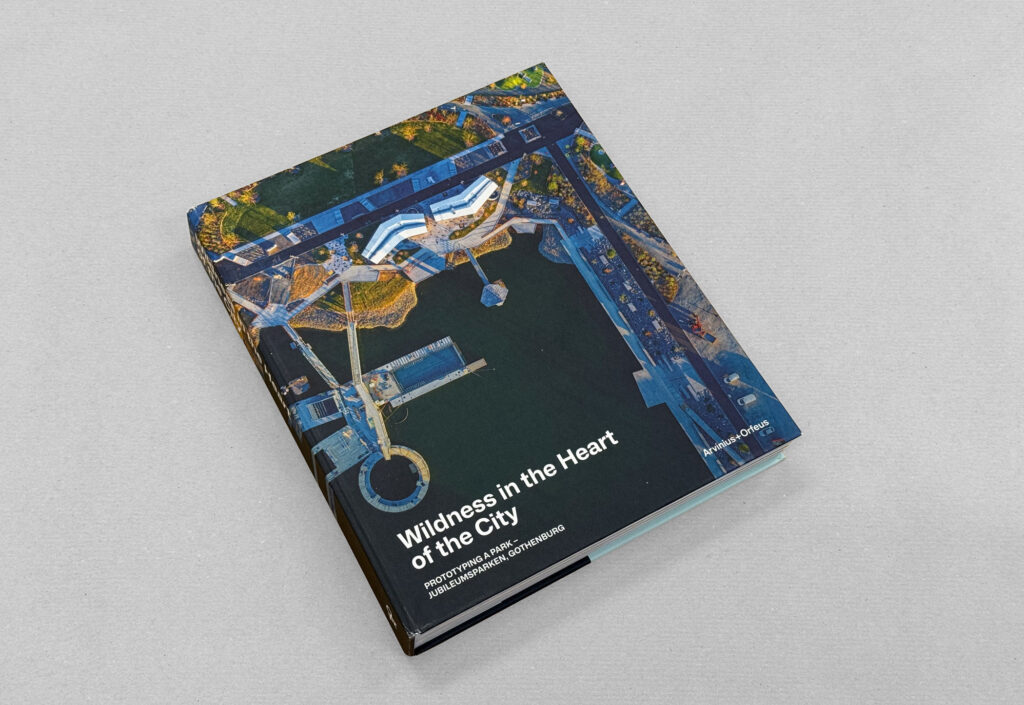
–
Essay Unframing Landscape in the book Wildness in the Heart of the City, Prototyping a Park – Jubileumsparken, Gothenburg
Author: Anders Kling / Publisher: Arvinius + Orfeus Publishing
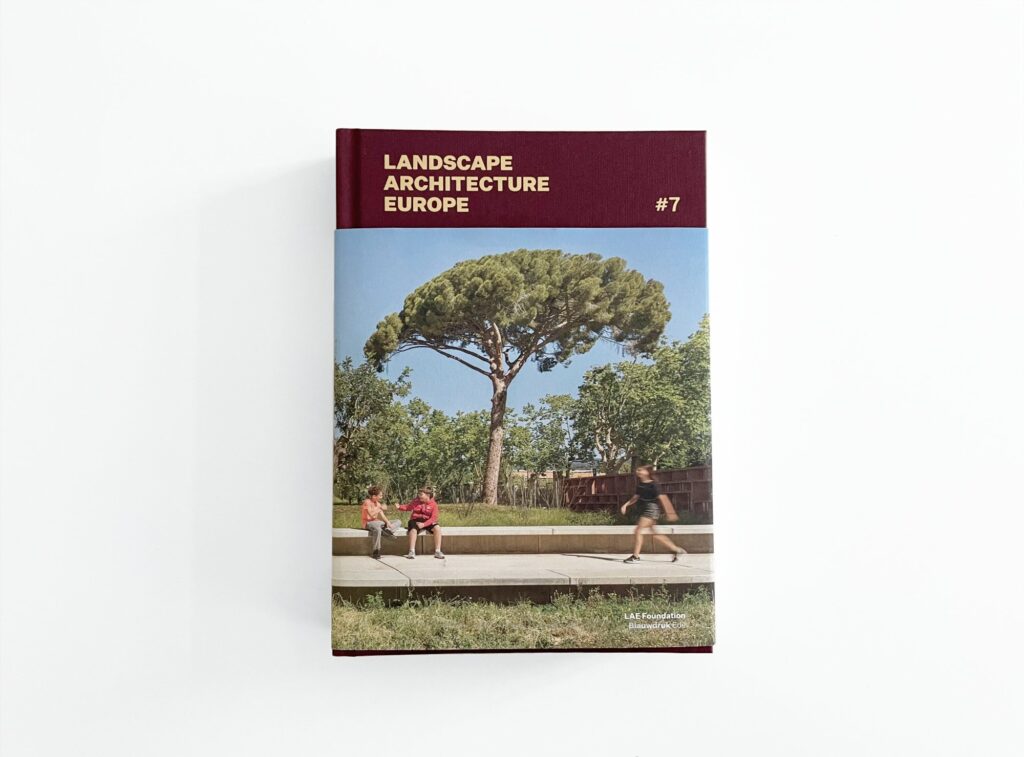
Essay Under the Rug – Aesthetics for Public Spaces in Times of Socio-ecological Transformation
in the book Landscape Architecture Europe #7: Full of Life
–
“Sky, earth, plants, and water are the four quintessential elements representing totality on Persian rugs in a garden motive called »chahar bagh«. Today, climate, soil, biodiversity, and water are the most troubled by the looming ecological crisis. The idiom “sweeping under the rug” is familiar in various languages, signifying the concealment of significant issues beneath an attractive yet deceptive facade that might as well be a garden. In landscape architecture, this metaphor could aptly be interpreted as greenwashing.”
“A low-res design creates conditions where ambiguity is not an obstacle but a productive tool in reforming perception. If we accept that aesthetics and politics are inseparable, then the notion of resolution in landscape architecture takes on a deeper significance. The idea that landscapes can be fully “solved” for everyone is a political fiction—an insistence on control where only limited control is possible. Ecological and social conditions are too entangled, too dynamic, too unresolved in themselves for any total resolution to ever be possible, let alone achieved.”
– Low-Res Design
Climate change ends the stability of Norberg-Schulz’s evergreen Genius Loci, reducing it to ‘keeping up appearances’. Centuries-old ideals still bind the discipline; emancipation lies in attending to the perception of change as it manifests across sites. In this sense, Genius Mutabilis replaces Genius Loci: an aesthetic of perpetual transition rather than existential permanence, acknowledging design as a species-wide endeavor entangled with shifting climates and evolving ecologies.
When ecological measures are embedded within capitalist systems, critique turns into fuel for greenwashing. By translating messy ecosystems into orderly, marketable frames, ecological design starts dissolving into compliance. Insect hotels and patches of curated “wildness” become banners of ecological declaration, easily re-absorbed into the very logic they seek to resist. Each time ecology is made compatible with market metrics or branding, it loses its power to obstruct.
– How Public Is Private? Aesthetics, Obligation, and the Ecology of Ownership
Here, the focus shifts from perception to mechanics: the double movement by which the human situates itself among other beings. On one side lies taming — anthropomorphisation, the projection of human traits onto animals, folding them into the family of resemblance (the cartoon lion singing Hakuna Matata, the loyal dog, Aesop’s fables). On the other side lies counter-taming — the negation of animality as the founding exclusion in defining human. Philosopher Giorgio Agamben’s “anthropological machine” names this structure: humanity defines itself only by cutting itself loose from “animal life.” Even the mirrored term “non-human” repeats the trap: animals defined by subtraction from the human.
– Out-of-hand: On Non-Humans And Non-Animals
The challenge is how to un-attach landscape from the aesthetic norms and typologies that have long defined it. Recent efforts in the somewhat problematic categorical ‘greenification’ of urban spaces have sometimes led to a more eclectic curiosity and a welcome erosion of typologies. But even so, many of these new designs still carry traces of traditional aesthetic norms, aestheticized nature, and controlled messiness, not very far from mimesis and romantic depictions. As much as it may sound problematic, landscape should be radically alienated and unfamiliarized. Paradoxically, it was these very aesthetic norms of familiarisation that alienated the landscape in the first place—applying a universal standard across diverse environments, rendering landscape an aesthetic category rather than a singularity of a place.
Harm of Harmonising
Contact
zas@landezine.com